Kinna Poulsen
Hansina Iversen: A Trailblazer
of Faroese Abstract Art Turns 60
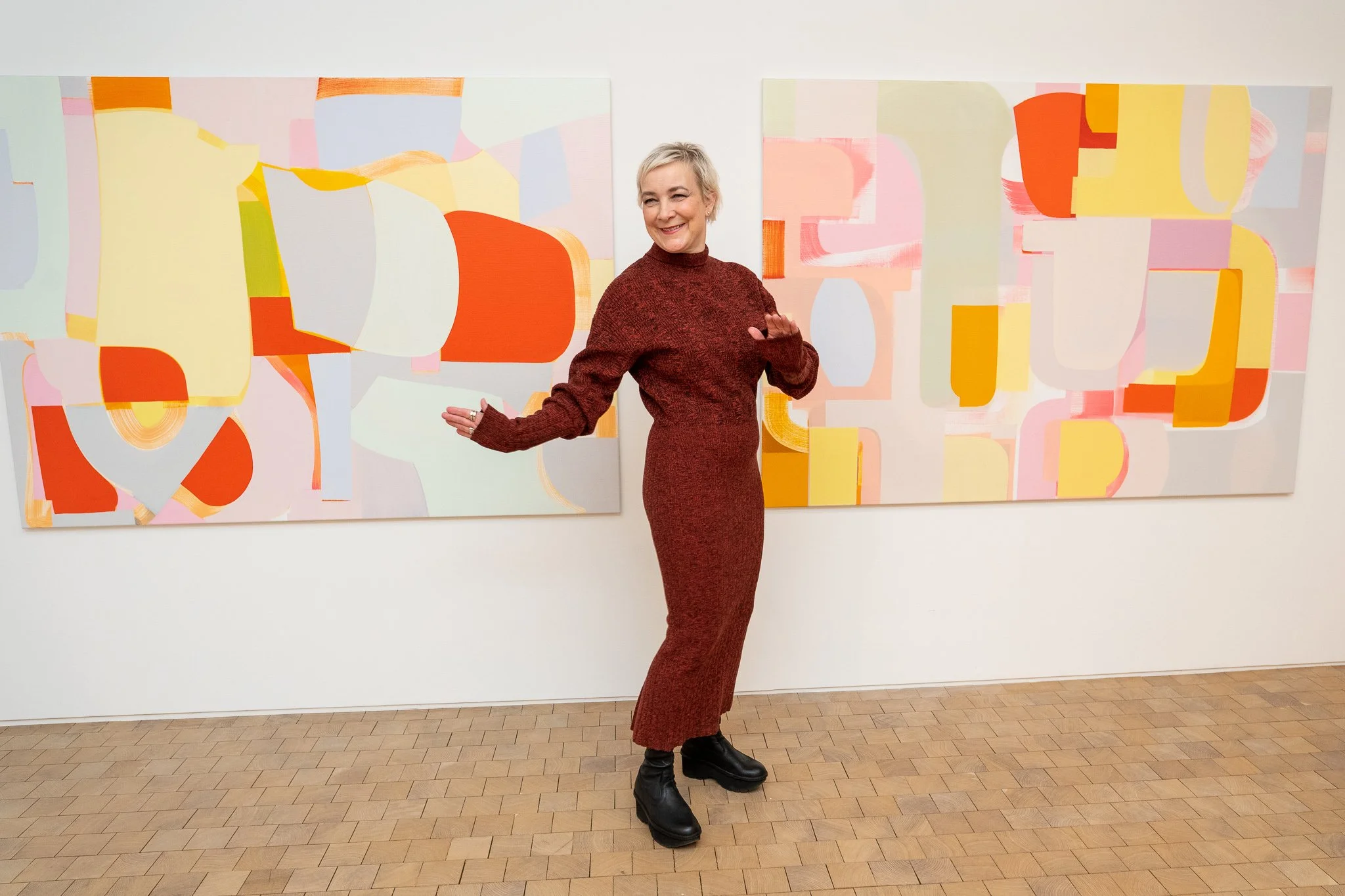
As the Faroese artist Hansina Iversen celebrates her 60th birthday, she stands as one of our foremost and most significant pioneers of non-figurative painting in the Faroe Islands. For more than thirty years, she has exhibited her work and participated in exhibitions both at home in the Faroe Islands and abroad in Copenhagen and New York.
One of these exhibitions took place in Paris. It was during the darkest days of the corona pandemic that Faroese art was exhibited in the City of Light itself—in the capital of Impressionism, where we dared to exhibit. But with paintings by Ingálvur av Reyni, Zacharias Heinesen, Rannvá Kunoy, and Hansina Iversen in our bag—well, then our self-confidence was at its absolute best. An unusually large number of people attended this French opening. I suppose it was one of the first exhibitions after the corona lockdown, and I remember the exhibition guests looking somewhat like pale, thin vampires, walking around the exhibition blinking up at the bright light emanating from the artworks on the wall.
But they were kind in Paris. Very kind—both the public and critics alike. One critic, Pierre Gelin-Monastier, recommended the exhibition as the most important one in Paris that week, and he was particularly captivated by Hansina. He compared her images to "la sagesse, la grace ou la jarre de la veuve de Zarepta"—to wisdom, grace, or the jar of the widow of Zareptath—meaning a light that flows continuously over us without ever running out. I remember when I, using my schoolboy French, managed to spell my way through this wonderfully kind review and wanted to explain all the praise to Hansina—how terribly uncomfortable she was. Hansina cannot cope with that kind of eulogy. She is a quite grounded person, and who knows if it doesn't pay off to look at her art with both eyes firmly planted on the ground.
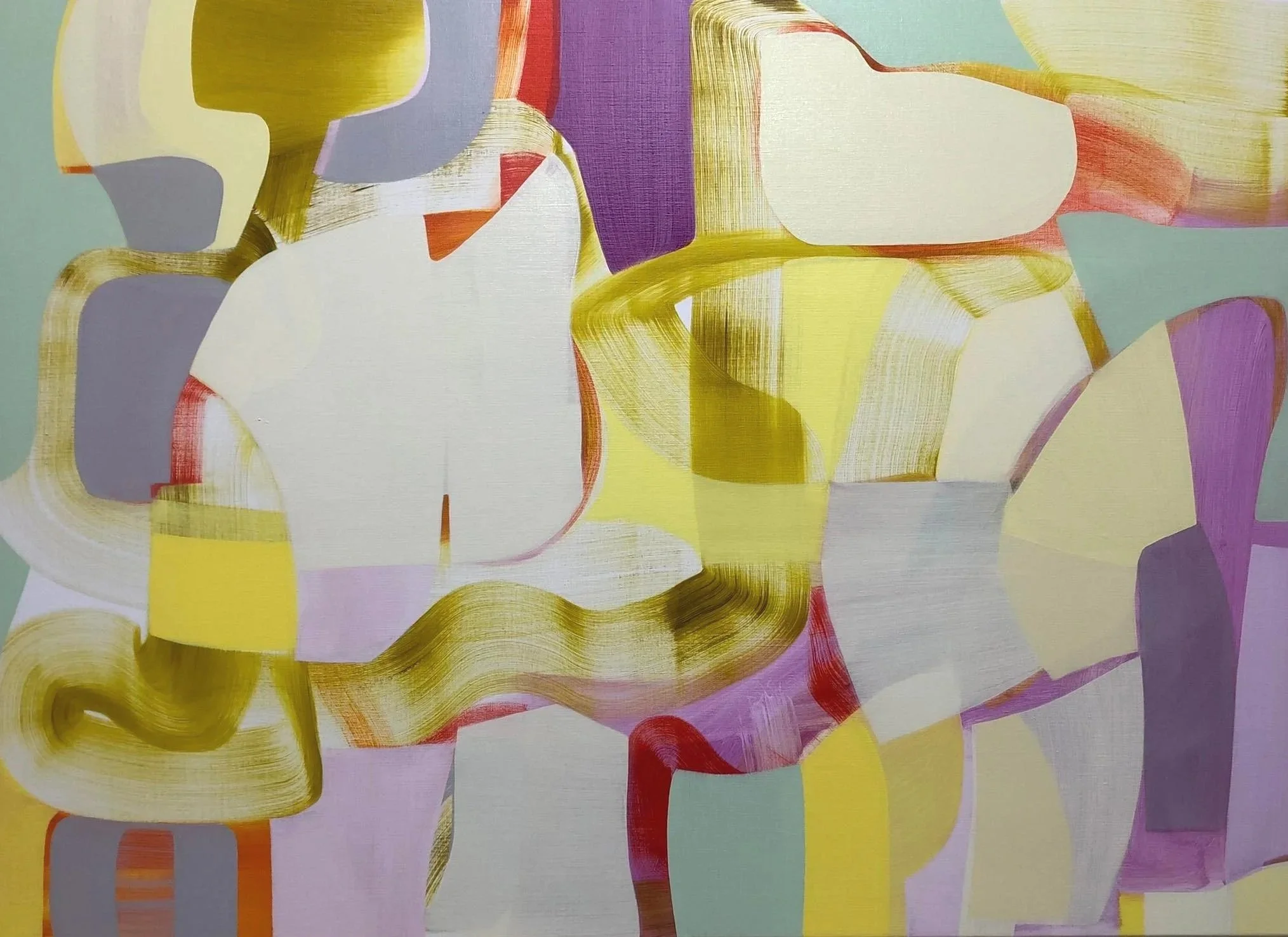
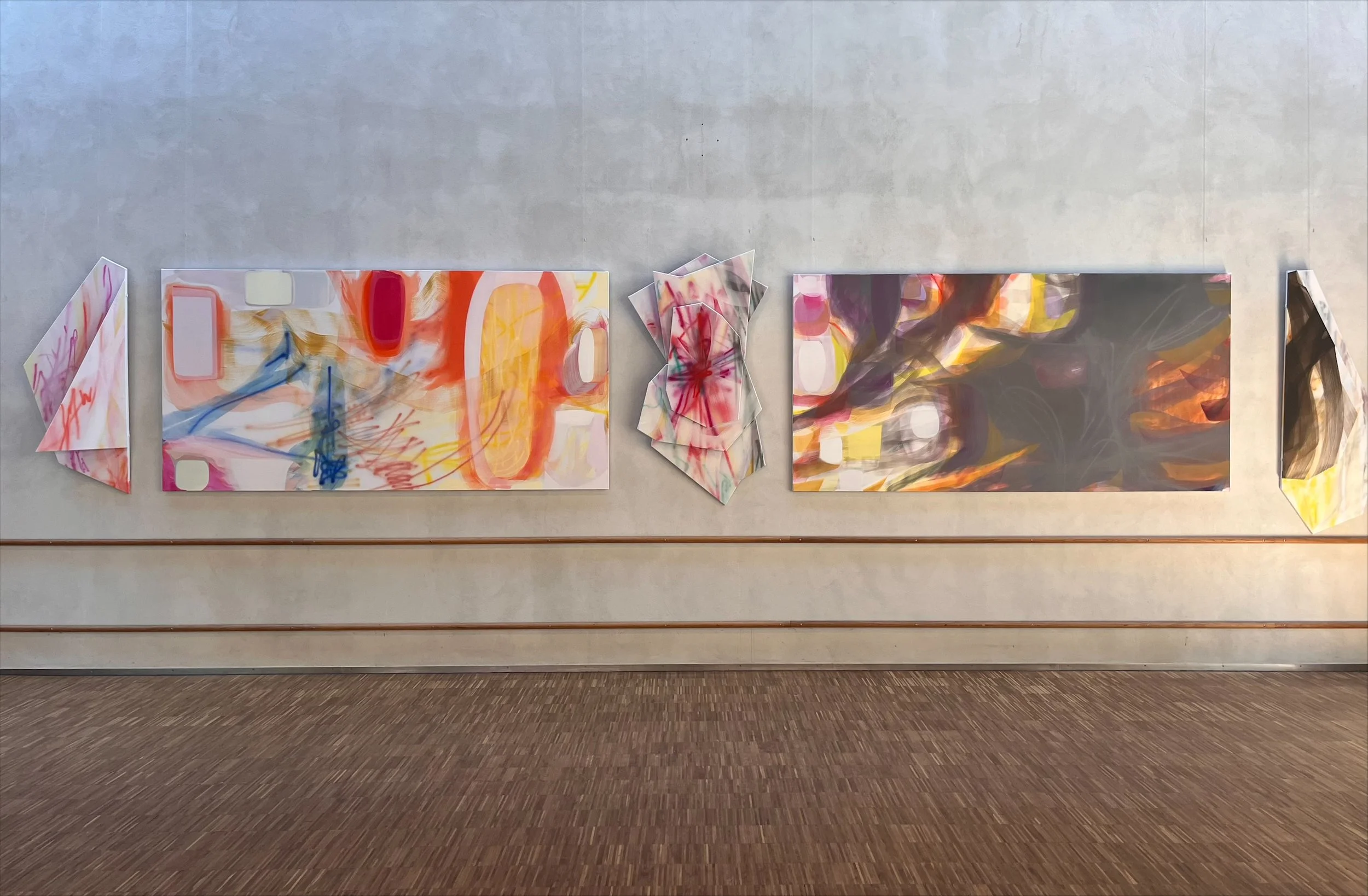
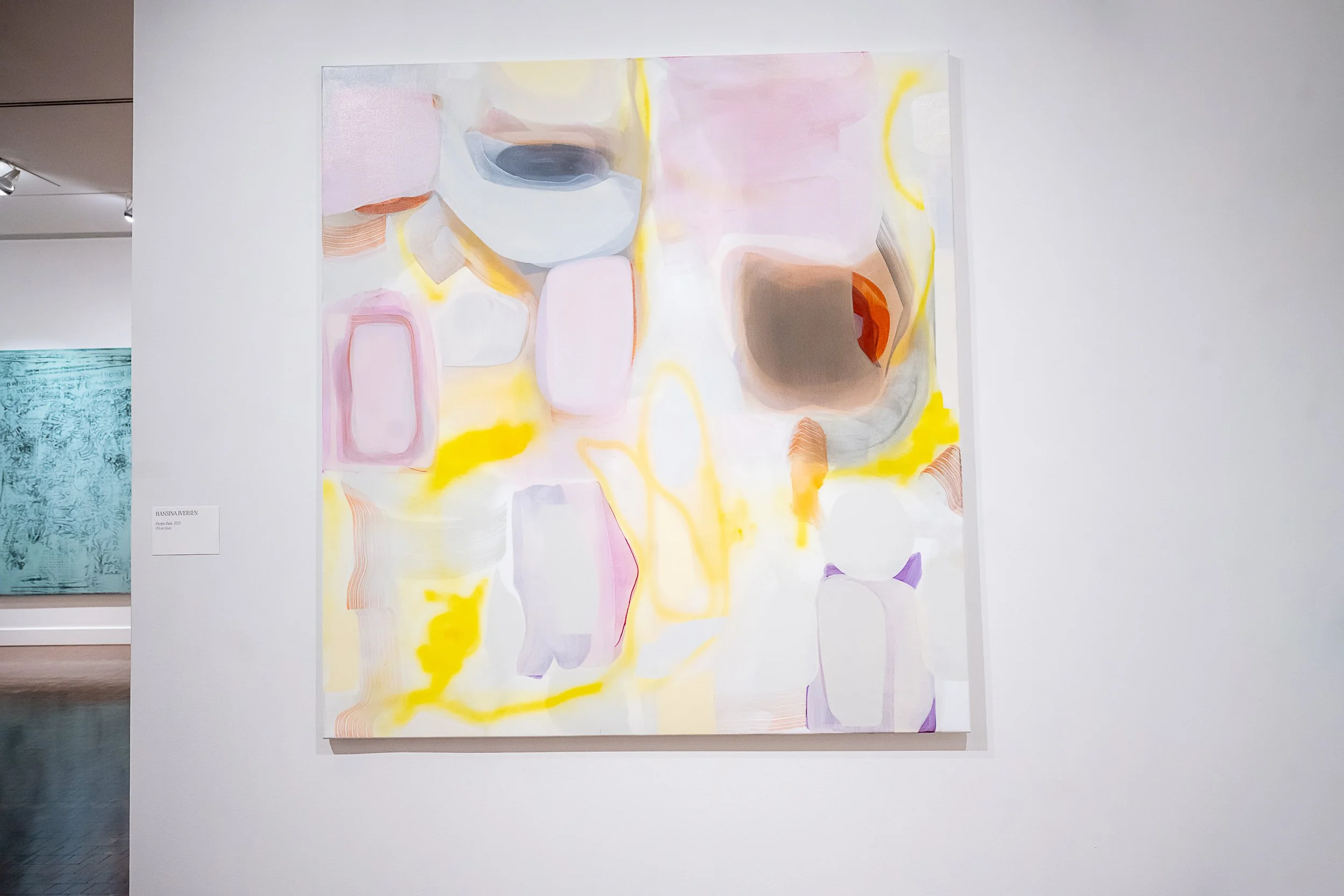
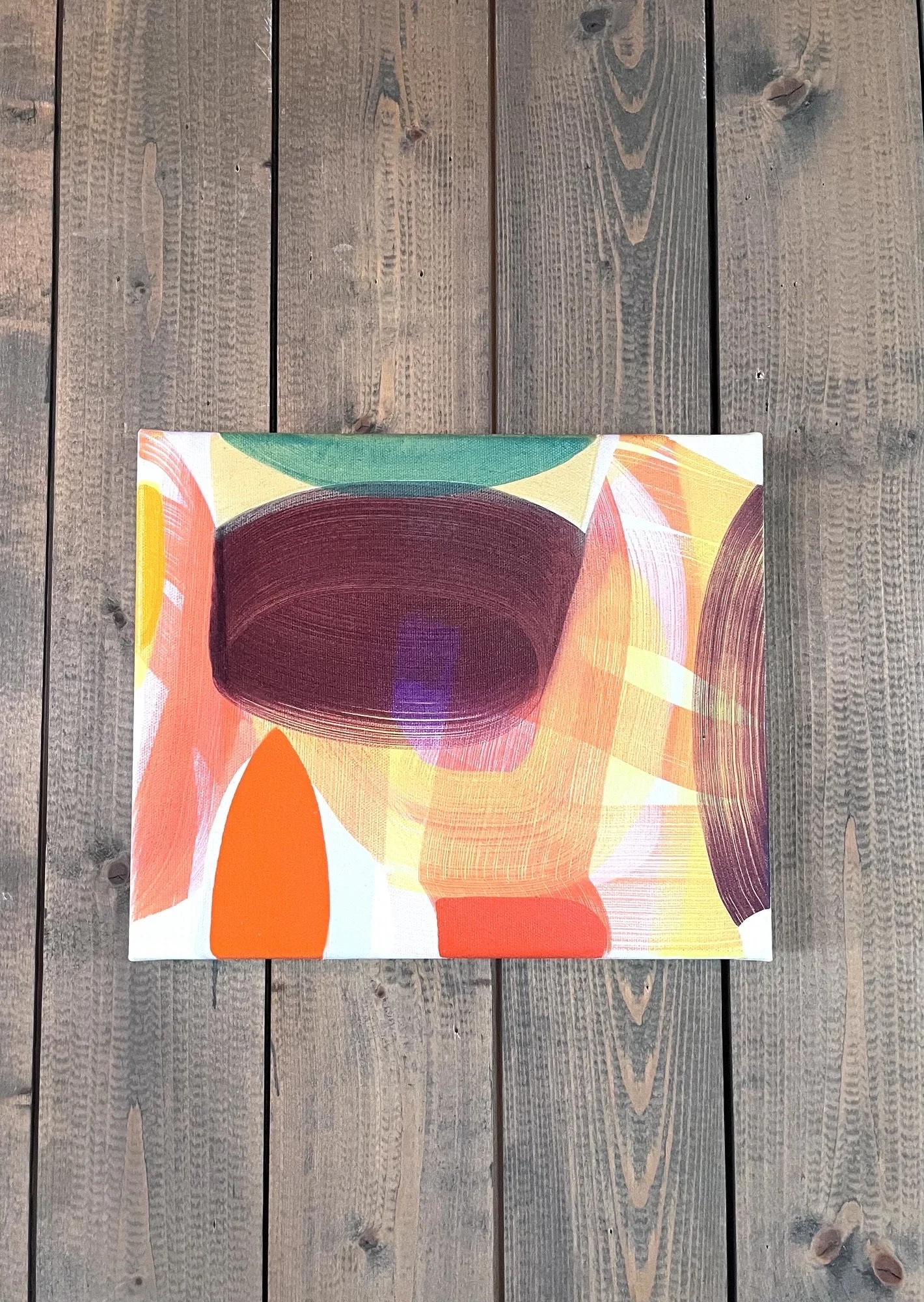
For even though she continues to paint these amazingly beautiful paintings with colourful rounded shapes in multiple layers with a sense of rhythm across the entire canvas and light peeling through colors, everything is still very concrete. The surface is a primed canvas. The light glimmers in the glowing paint, but it also shines from the white ground, which can be glimpsed in the spaces between and behind the colors.
Hansina is a so-called "painter's painter" who excels technically and in craftsmanship, but she is also a graphic artist whose extensive collaboration with Steinprent the graphic workshop in Tórshavn has yielded almost a hundred graphic works. Hansina has developed a distinctive graphic style that has influenced the imagery of her paintings with an increasingly complex structure where layer is placed upon layer, just like in lithographic technique where each color is printed separately. The many prints that Hansina Iversen has created at Steinprent encompass both the simple and the maximalist, but here too, the concrete material affects the result in beautiful, thin washes that the artist creates with the brush after dipping it in fluid ink. Large printing projects with many runs and color layers have challenged the artist and sharpened her analytical skills, and this is reflected in her paintings.
Together with Rannvá Kunoy, Hansina Iversen is a trailblazer within non-representational painting in the Faroe Islands. Historically, this art is off course linked to a transition that occurred in world art after World War II, where the artistic center was no longer Paris, but New York. Hansina herself has explained in several interviews how a study trip to New York was of fundamental importance to her when she experienced the giant paintings of Mark Rothko, Barnett Newman, Helen Frankenthaler, and other Color Field painters for the first time. This style is called Abstract Expressionism, and it seems obvious to categorize Hansina's art as some kind of offshoot of this art genre. Yet Hansina's works are quite different compared to those of her American colleagues, and I believe the difference has only grown in this century. In her pictures, it is not per se about metaphysical infinity, pop-like flatness, or random Tachist smearing—her works are more diverse, deep, and controlled.
Even though the compositions are highly complex, they appear remarkably clear and non-accidental, as if the placement of every stroke, trace of spray paint, and painted shape is precisely controlled, just as the layers are carefully coordinated into a cohesive whole. This sense of cohesion grows ever stronger and can be sensed both within individual works and between them. At the same time, these images seem immensely present as they unfold here and now, with a material basis primarily in the sensitive and slow-drying oil paint, which in some places steps forward glossily from the whole while other faint surfaces recede into an organically undulating unity.
In front of a painting by Hansina, the viewer must make an effort and take plenty of time to look and look again. The strong colorism and flickering power of light, along with the energy of the brushstrokes, can bring to mind Monet and other Impressionist masters, but perhaps the time has come to drop the comparisons now that Hansina is turning sixty. She needs no comparison at all, but her work stands up to being compared with the absolute best.
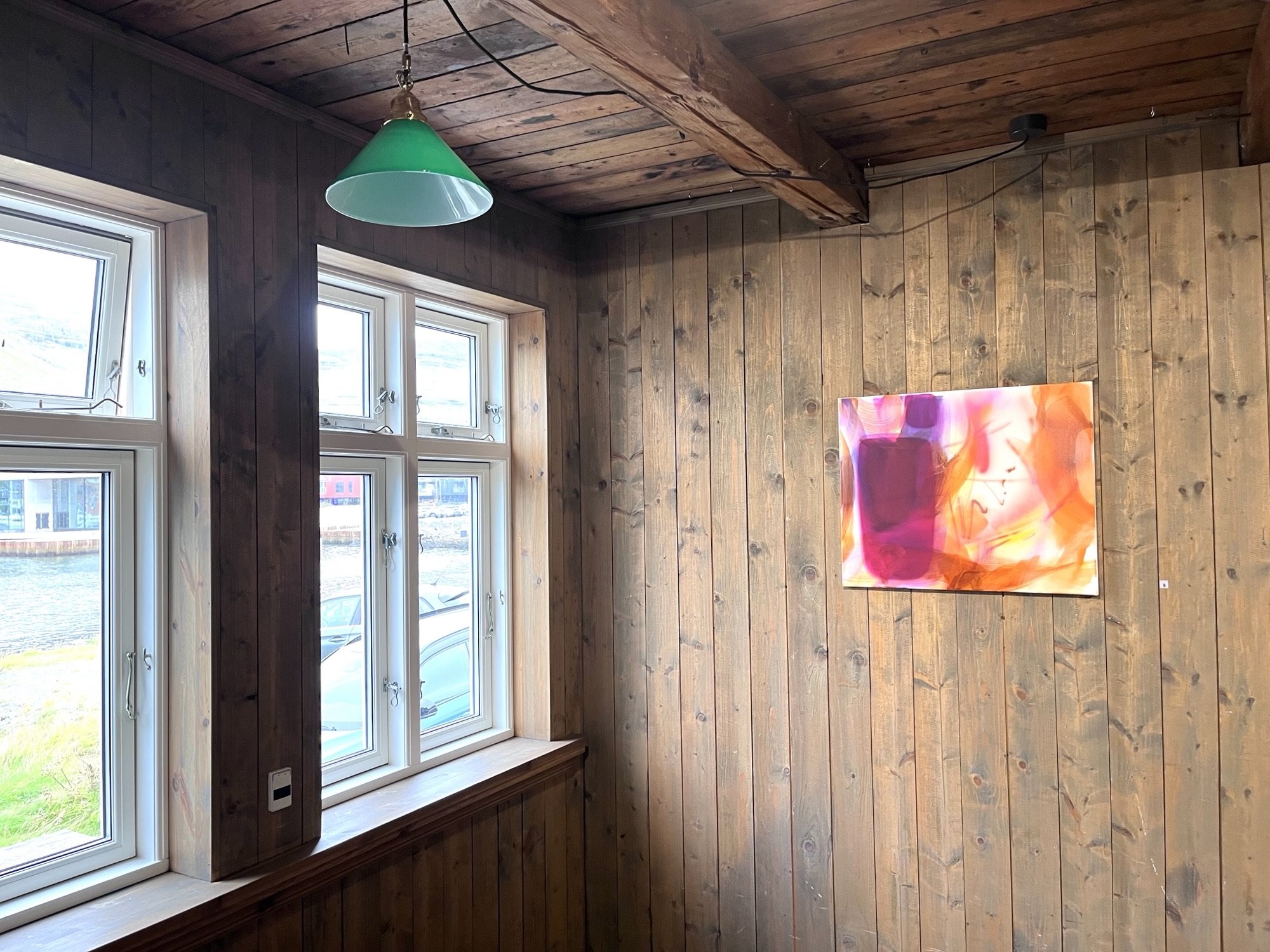
Her works can currently be seen at the exhibition Impromptu at Gamla Seglhúsið in Klaksvík, and on Friday, September 11, her birthday exhibition SEXAGINTA opens at Steinprent, with an emphasis on her graphic works.
A heartfelt congratulations, dear Hansina.
Kinna Poulsen